
Spinning the Hits: When DJs Made Rock and Roll Matter

Want to learn more about radio's influence on past musical hits? Join me for One-Hit Wonders: 12 Unforgettable Moments from the 1960s on Tuesday, Jan. 20, 2026.
Click here for more details!
It’s safe to say that without radio, rock and roll would never have become the cultural phenomena that it did. Just imagine that for a moment. No radio means no Elvis. No Beatles. No Janis Joplin or Rolling Stones. And no Bob Dylan.
For anyone born before 1970, music was something you experienced together. There were no personal playlists and no algorithms catering to every whim. What we had was AM radio—one song at a time, moving across cities and state lines, reaching thousands of listeners all at once. And just as important as the signal itself was the voice behind it: a disc jockey with a microphone who could change everything with a single spin.
Success in rock and roll didn’t begin with marketing plans or data analysis. It began when a DJ believed in a record enough to put it on the air—and keep playing it. Radio wasn’t just how people heard new music; it was how rock and roll became rock and roll.

In the 1950s, the music that would come to define a generation was still risky, raw, and often unwelcome. Many stations refused to play it. Record executives didn’t always understand it. But AM radio had something powerful: immediacy. A DJ could hear a song, trust their instincts, and put it in front of listeners in real time. If the phones lit up, a hit was born—not in a boardroom, but somewhere between a turntable and an antenna.
Few moments capture that better than the night Elvis Presley first came blasting out of Memphis radios. In July 1954, Elvis was an unknown singer who had just recorded a loose, spontaneous version of Arthur “Big Boy” Crudup’s blues song “That’s All Right” at Sun Records. The recording didn’t fit neatly into country or rhythm and blues, and Sam Phillips wasn’t sure what to do with it. Enter Dewey Phillips—better known as “Daddy-O” Dewey—the charismatic and unpredictable host of WHBQ’s Red, Hot & Blue in Memphis, Tennessee. Dewey played the record on his late-night AM show…and then played it again. And again.
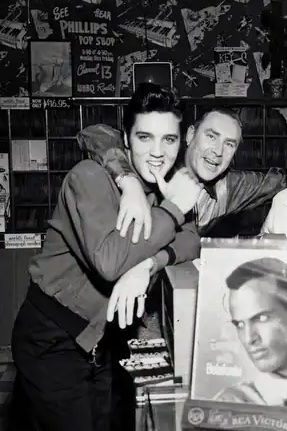
Listeners flooded the station with calls asking who the singer was. Sensing the moment, Dewey tracked down a nervous Elvis and brought him into the studio for an impromptu interview, even asking which high school Elvis attended (so listeners would know he was white). It was a revealing snapshot of the era—and a reminder of just how much power one DJ could wield. That single night of radio airplay didn’t just introduce a song; it launched a career and helped ignite rock and roll itself.
Stories like Elvis’s weren’t rare—they were the new process. DJs like Alan Freed used AM radio to introduce rhythm and blues records to teenage audiences across racial lines, helping popularize both the music and the term “rock and roll.” Freed didn’t wait for permission. He trusted what he heard and passed it along to listeners who trusted him in return. Later, Wolfman Jack would turn that faith into something almost mythic, broadcasting from high-powered border stations with a voice as wild as the music itself. When the “Wolfman” played a record, it wasn’t just exposure—it was an endorsement. Listeners would respond by following the artists and buying the singles they heard on the radio.
By the mid 1960s, rock music had matured, but radio’s role remained just as critical. Innovators still needed supporters. When the Beach Boys released “Good Vibrations” in 1966, it was unlike anything else on the radio—fragmented, layered, sophisticated, and structurally unconventional. Built over months of studio experimentation and featuring unusual instruments like the electronic Theremin, the song made even Brian Wilson wonder if radio would embrace it.
AM DJs answered that question quickly. Stations like KHJ in Los Angeles—one of the most influential Top 40 outlets in the country—put “Good Vibrations” into heavy rotation. DJs didn’t shy away from its odd structure; they played it enough that listeners learned how to hear it. Familiarity turned complexity into excitement. The song soared to No. 1 in both the U.S. and the U.K., redefining what a pop single could be—not because it followed the rules, but because radio gave audiences the time and repetition to grow with it.

What ties all this together is a simple truth that’s easy to forget today: hits were once human decisions. Before algorithms predicted your musical taste, a disc jockey could decide what you needed to hear. AM radio was communal and immediate. Tens of thousands of young people heard the same song at the same moment, introduced by a voice they trusted. DJs didn’t just play music—they helped audiences make sense of sounds that were new, challenging, or ahead of their time.
Rock and roll’s rise wasn’t inevitable. It needed champions. AM radio provided the signal, and DJs provided the courage. Every revolutionary guitar riff and genre-defining song had to survive a moment of uncertainty at a turntable. Long before songs “went viral,” they went on the air—spun by someone willing to take a chance and press play one more time.
Rob
Do you remember a local DJ who made a difference in the music you listened to growing up? Tell us about it in the comments.


Comments